Health and safety in industrial demolition revolves around one document: the health and safety plan, which the contractor draws up on the basis of the project’s health and safety study and which must be approved before work starts. Around it sit the coordination between companies, the presence of designated safety supervisors (known in Spain as recursos preventivos), each worker’s training and protective equipment. This article explains what each of these elements requires and how it is applied on a real site.
What is a demolition health and safety plan?
It is the document in which the company carrying out the demolition explains how it will work safely on that specific site. It is governed by Royal Decree 1627/1997 on health and safety on construction sites, which also applies to demolition work. It fits into a chain of documents, each with a different party responsible:
| Document | Who prepares it | When |
|---|---|---|
| Health and safety study (or basic study) | A competent technician appointed by the client commissioning the work (the promotor) | While the project is being drafted |
| Health and safety plan | Each contractor, based on the study and on how it will carry out the work | Before work starts; it is approved by the health and safety coordinator for the construction phase |
| Notice of opening of the workplace | The contractor, to the labour authority, including the plan | Before work begins |
| Site incident book (libro de incidencias) | Kept on site to monitor and follow up the plan | Throughout the work |
A full study is mandatory if any of these conditions applies: a contract price (presupuesto de ejecución por contrata) of €450,759.08 or more; a duration of more than 30 working days with more than 20 workers on site at the same time at any point; more than 500 worker-days in total; or work on tunnels, galleries, underground pipelines or dams. For all other work, a basic study is enough.
What should the plan cover in an industrial demolition?
A generic plan is no use. In an industrial demolition, it has to go into the detail of that particular installation:
- The demolition method and sequence, with the measures to keep the structure stable at every stage.
- Work involving special risks: at height, oxy-fuel cutting, crane operations, confined spaces such as tanks or silos.
- Risks from the surroundings: plants in production, explosive atmospheres, power lines, internal traffic.
- The collective and personal protection planned for each task.
- The health and safety organisation: who the designated safety supervisor is and what to do in an emergency.
The plan is not set in stone: the contractor can amend it as the work progresses or as unforeseen issues arise, but every change needs the coordinator’s express approval.
How are companies working on the same site coordinated?
When more than one company, or a company and self-employed workers, are involved on a site, the client must appoint a health and safety coordinator for the construction phase. The coordinator’s job is to make sure that one party’s measures don’t clash with another’s and that no one works in a hazardous area created by another company.
In an industrial demolition there is an extra level of coordination: the plant itself. If the facility is still running, the company that owns the workplace and the demolition company must exchange information on each other’s risks, emergency procedures and work permits, as required by the rules on the coordination of business activities (Royal Decree 171/2004). This is what makes it possible, for example, to use oxy-fuel cutting a few metres from a line that is still producing.
When does a site need a designated safety supervisor?
The designated safety supervisor (recurso preventivo) is a person with health and safety training who checks on site that the measures in the plan are being followed. In construction and demolition, their presence is mandatory in several situations, including when work involving special risks is carried out, as listed in Annex II of Royal Decree 1627/1997. Several of these are common in industrial demolition:
- A particularly serious risk of collapse or of falling from height.
- Assembly or dismantling of heavy prefabricated elements.
- Exposure to chemical agents posing a particularly serious risk.
- Work close to high-voltage power lines.
The health and safety plan must set out how this presence is organised and who takes it on in each phase.
What training and protective equipment do staff need?
Spain’s Law 31/1995 on Occupational Risk Prevention requires every worker to receive sufficient and appropriate theoretical and practical training for their job. In industrial demolition, depending on the task, that includes work at height, oxy-fuel cutting, operating machinery and cranes, confined spaces, explosive atmospheres and the site emergency plan.
Personal protective equipment (PPE) is the last line of defence, after collective protection. These are the usual items:
| Risk | Personal protection |
|---|---|
| Falling objects and knocks | Safety helmet |
| Spatter and radiation from oxy-fuel cutting | Goggles or a welding face shield, and flame-resistant clothing |
| Cuts to the hands and puncture injuries | Gloves offering mechanical protection, and safety footwear with toe caps and puncture-resistant soles |
| Noise from machinery and cutting | Hearing protection |
| Dust | A filtering face mask of the type specified in the risk assessment |
| Falls from height where collective protection isn’t possible | Fall-arrest harness with an anchor point |
| Moving machinery and lorries | High-visibility clothing |
Which special risks need to be treated separately?
Asbestos
Work involving a risk of exposure to asbestos is governed by Royal Decree 396/2006. It can only be carried out by companies on the RERA (Spain’s Register of Companies with Asbestos Risk), with a work plan approved by the labour authority, and removal must be completed before demolition.
Explosive atmospheres (ATEX)
Chemical, pharmaceutical and fuel plants may have areas classified as ATEX zones. There, everything is decontaminated before dismantling, the atmosphere is monitored continuously and only certified tools and equipment are used.
Confined spaces
Gases can build up, or oxygen can run short, in tanks, silos and pits. Before anyone goes in, the atmosphere is measured and the space ventilated, and work is done under a specific permit with someone keeping watch from outside.
We explain how the work is planned technically to reduce these risks, from the preliminary survey to dust control, in how to plan a safe demolition.
Health and safety on Alberich’s industrial demolition projects: ISO 45001 and Zero Accidents
At Alberich we have an occupational health and safety management system certified to ISO 45001, together with ISO 9001 and ISO 14001 (you can see them in our certifications). At our plants we also work with a Zero Accidents culture.
On site, working with our own machinery and team makes it easier to keep the same discipline, because the training, equipment maintenance and methods are the same on every job. We have ATEX-trained staff and equipment certified for explosive atmospheres, and on every project we prepare the health and safety study and the waste management plan as part of our end-to-end service.
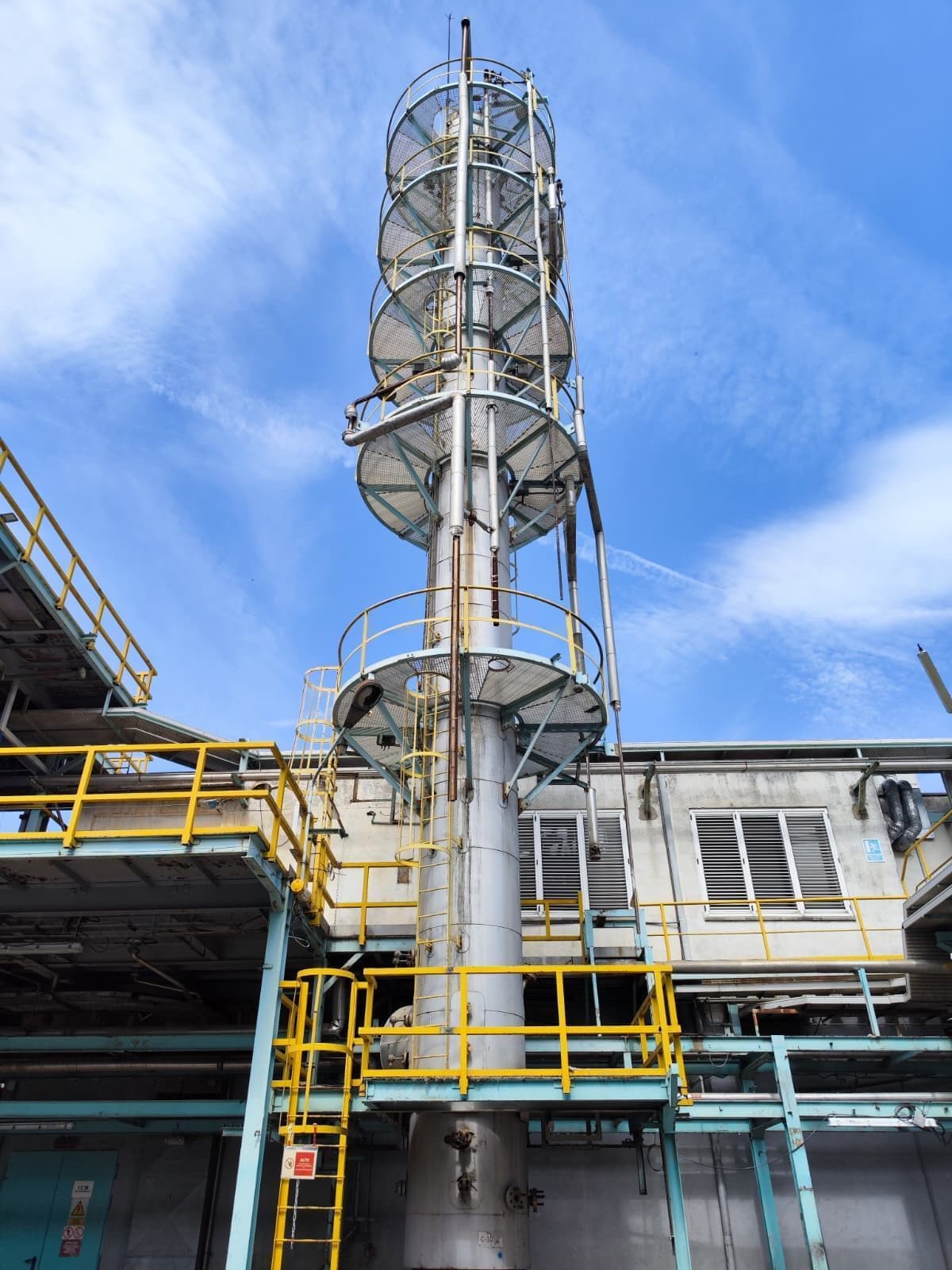
Some results: the 30-metre distillation column in an ATEX zone, dismantled in 5 days without incident; the footbridge over a live railway, removed on night shifts without interrupting rail traffic; and the two RTG port cranes at a port in full operation. You can see the rest on our industrial demolition page.
Frequently asked questions
Does a small demolition also need a health and safety plan?
Yes. Even if the work only requires a basic study, each contractor must draw up its own health and safety plan from it. What changes is the length of the documents, not the obligation.
Who approves the plan if there is no health and safety coordinator?
When a coordinator doesn’t have to be appointed, for example because only one company is working on site, the coordinator’s duties are taken on by the project’s technical management team (dirección facultativa), which approves the plan. On public sector works, the plan is submitted to the public authority that awarded the contract.
Who can act as the designated safety supervisor?
A worker designated by the company, a member of its in-house health and safety service or a technician from its external health and safety provider. In every case, they need knowledge of and experience in the work involved and, as a minimum, basic-level health and safety training.
What is the difference between ISO 45001 and complying with health and safety law?
Complying with the law is mandatory for every company. ISO 45001 is a voluntary international standard that certifies the company has a system for managing safety and improving it continuously, audited by an external body.
If you are commissioning an industrial demolition, ask to see the health and safety plan before work starts and check that it deals with your installation and not just any site.