If you are looking for an industrial demolition company in Barcelona or the surrounding metropolitan area, you need one that can handle three things at once: the paperwork with the town council, safe execution in a setting that is almost always hemmed in by other industrial buildings, homes or activity, and the traceable management of hundreds of tonnes of waste and scrap. Proximity counts too: the closer the plant where the materials are processed, the fewer the trips, the shorter the timescale and the lower the cost.
What makes industrial demolition in Barcelona different?
Industry in the Barcelona area is densely packed and old. The industrial estates of the Baix Llobregat, the Vallès, the Zona Franca and the Maresme are full of buildings that have been in use for decades, many of them built up against others still in operation and, increasingly, against residential neighbourhoods that have grown up around them.
That translates into very specific site conditions:
- Party walls and neighbours. Many industrial units share a wall with the one next door, and the demolition must not damage the structure that remains standing.
- Access and working hours. Narrow streets, limited loading areas and working hours set by each municipality’s by-laws.
- Materials from another era. In buildings that pre-date 2002, the year asbestos was banned in Spain, fibre cement roofs are common and have to be identified before work begins.
- Land that changes use. Many demolitions are carried out not because the building is derelict, but because the industrial land is being redeveloped for another activity or for housing, as has happened in entire districts of the city.
What permits does an industrial demolition need in Barcelona and the surrounding area?
Every town council has its own by-laws and its own procedure, so the starting point is always to check with the municipality where the building is located: Barcelona is not the same as L’Hospitalet, Sabadell or Rubí. Even so, there is a common core that comes up on almost every demolition job:
- The municipal authorisation (a works licence or whatever procedure the council requires), with a demolition design signed by a qualified professional.
- The waste management study required by Royal Decree 105/2008, Spain’s regulation on construction and demolition waste, with an inventory of hazardous waste and, where regional legislation provides for it, a deposit or financial guarantee to ensure the waste is properly managed.
- The health and safety study under Royal Decree 1627/1997 and, before work starts, notification to the labour authority that the workplace is opening, together with the health and safety plan.
- If lorries, containers or cranes will occupy the public highway, the corresponding permit to occupy the highway.
In our guide to end-to-end demolition management we explain who prepares each document and at what stage of the project it comes in. If there is asbestos, it must be removed by a company registered on the RERA (Spain’s Register of Companies with Asbestos Risk), with a work plan approved by the labour authority, and always before the demolition.
How do you choose an industrial demolition company in Barcelona?
The quote alone is not enough to compare companies. What really makes the difference in an industrial demolition is how the proposal has been put together and who is going to carry out each part of it. These are the questions worth asking before you sign:
| What to ask for | Why it matters | How to check |
|---|---|---|
| A site visit and prior technical survey | Without measuring the structure or identifying the materials, the quote is an estimate that may change halfway through the job. | Ask what has been measured, which materials have been inventoried and whether the price is fixed. |
| Own machinery, transport and team | A contractor that controls its own resources controls its timescales and its safety. | Ask which parts of the job the company will carry out with its own resources. |
| Authorisation as a waste management company | The waste remains the producer’s responsibility until there is documentary proof that it has been properly managed. | Waste management authorisation number, the expected EWC codes (European List of Waste) and the certificates you will receive at the end. |
| Experience in your sector | Dismantling a chemical plant is not the same as dismantling a food plant or a textile mill. | Projects similar to yours, with figures for timescale and recycling. |
| Certified management systems | They show method and control in quality, environmental management and occupational health and safety. | Current ISO 9001, 14001 and 45001 certificates. |
If your plant will keep producing while part of it is dismantled, add one more question: how the site will be sectioned off so that the work does not interfere with production. We go into this in our article on working without stopping production.
Why does the distance between the site and the recycling plant matter?
In an industrial demolition, most of the work after the structure comes down is moving material: structural steel, tanks, cabling, concrete. Every kilometre between the site and the treatment plant is multiplied by the number of trips, and that weighs on the cost, the timescale and the project’s emissions.
Proximity also gives you room to react. If the job produces more scrap than expected, a container fills up sooner than planned or the pace has to be adjusted to a production shutdown, having the plant and the fleet close by means you can respond the same day. That’s why, when you compare companies, it’s worth asking not only where their office is, but where the materials coming out of your building will be processed.
Industrial demolition from Castellbisbal: how we work at Alberich
Alberich is a Barcelona company: it started out in 1900 recovering materials, by 1930 it was already recycling on an industrial scale in Poblenou, and it has been carrying out demolition and industrial dismantling since 1960. Today its head office and main plant are in Castellbisbal, within the metropolitan area, and it has two more sites of its own in La Llagosta and Constantí. From there we cover Catalonia, the Valencian Community and Aragon directly, and we assess projects in the rest of mainland Spain case by case.
We follow the same approach on every demolition:
- On-site technical survey with metal analysers and thickness gauges, to quantify the recoverable materials and finalise the quote.
- Documentation: demolition design, health and safety study, waste management plan and licence applications.
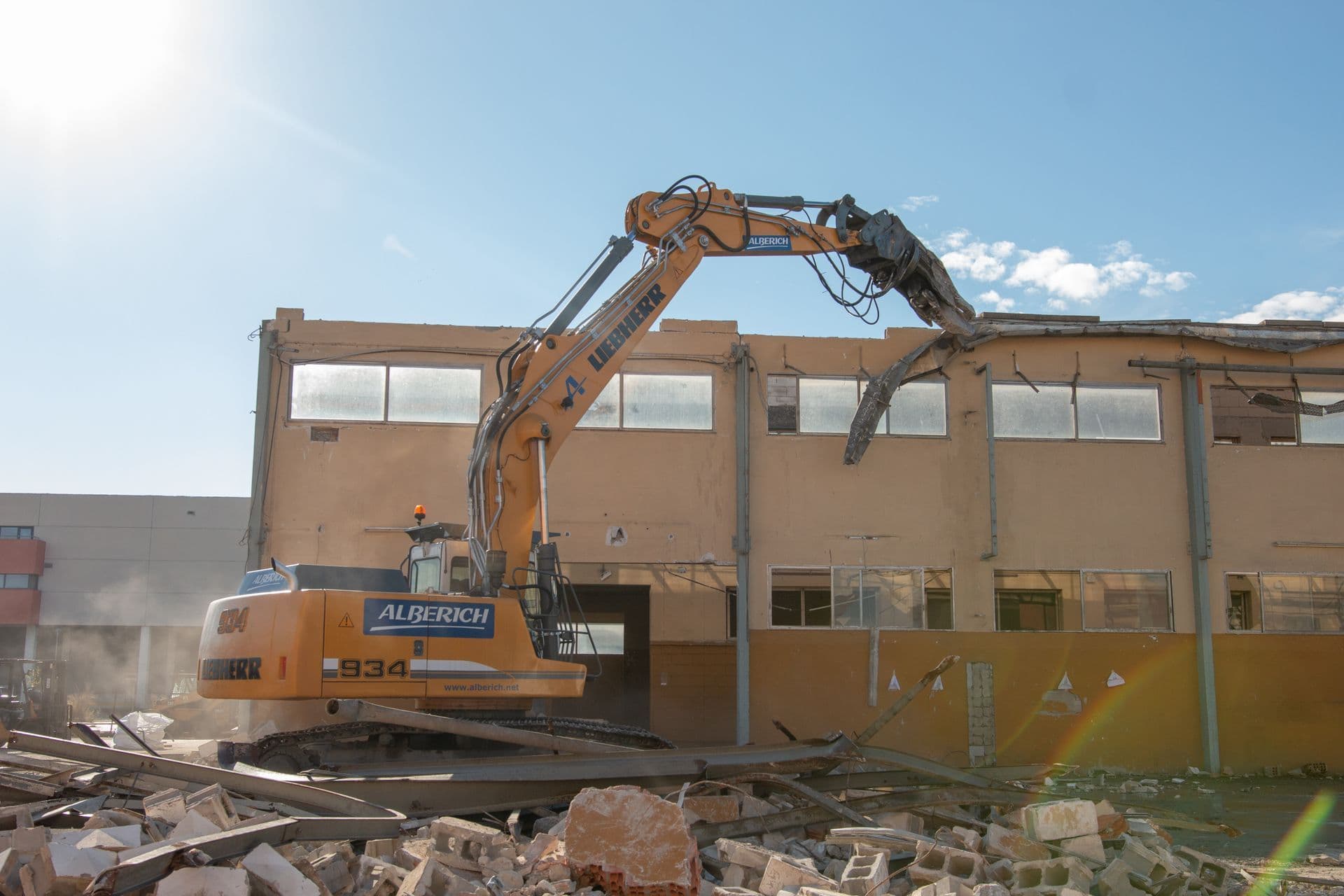
- Execution with our own machinery and team, including at plants that remain in production.
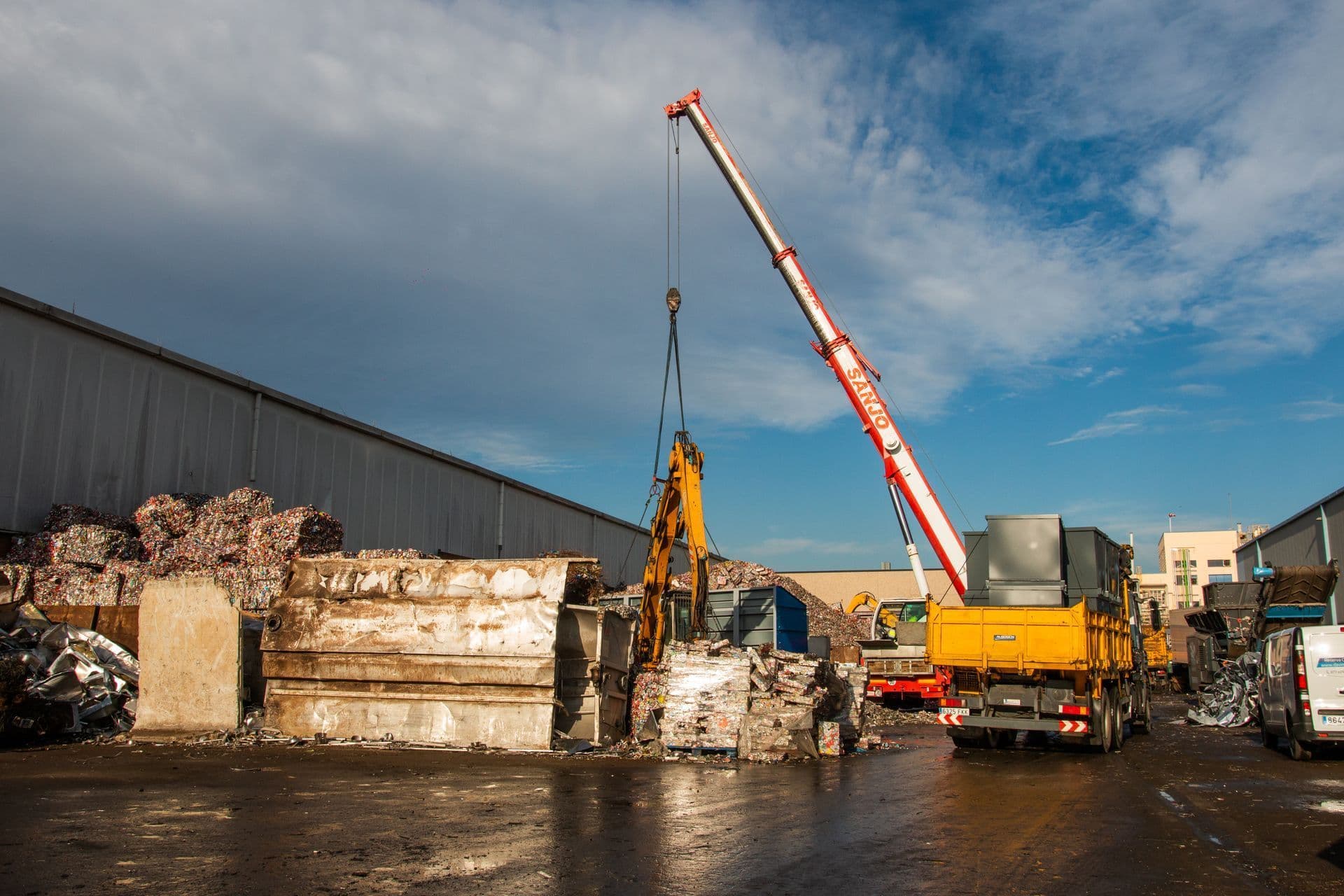
- Transport with our own fleet and containers from 1 to 30 m³ for segregation at source (see our logistics and collection service).
- Metal processing at our own plant, with the 4,000 hp shredder at Castellbisbal and 600–1,000 t shears, and certificates issued under our waste management authorisation no. E-345.97.
Some reference projects, with their actual figures:
| Project | Sector | Figures | Recycling |
|---|---|---|---|
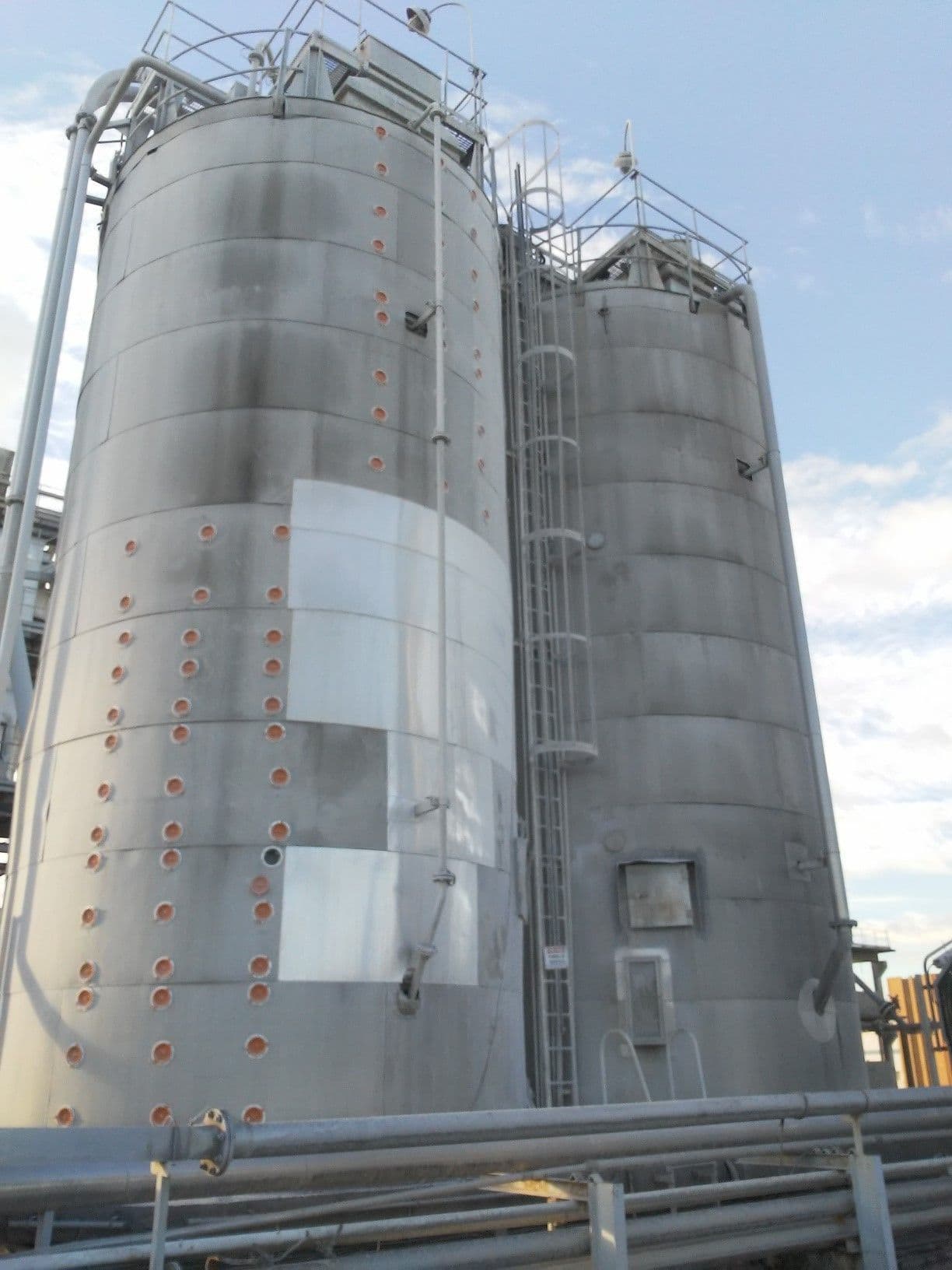
| Industrial storage tank | Chemicals | 30 m high, 1,410 m³, 15 days | 100% |
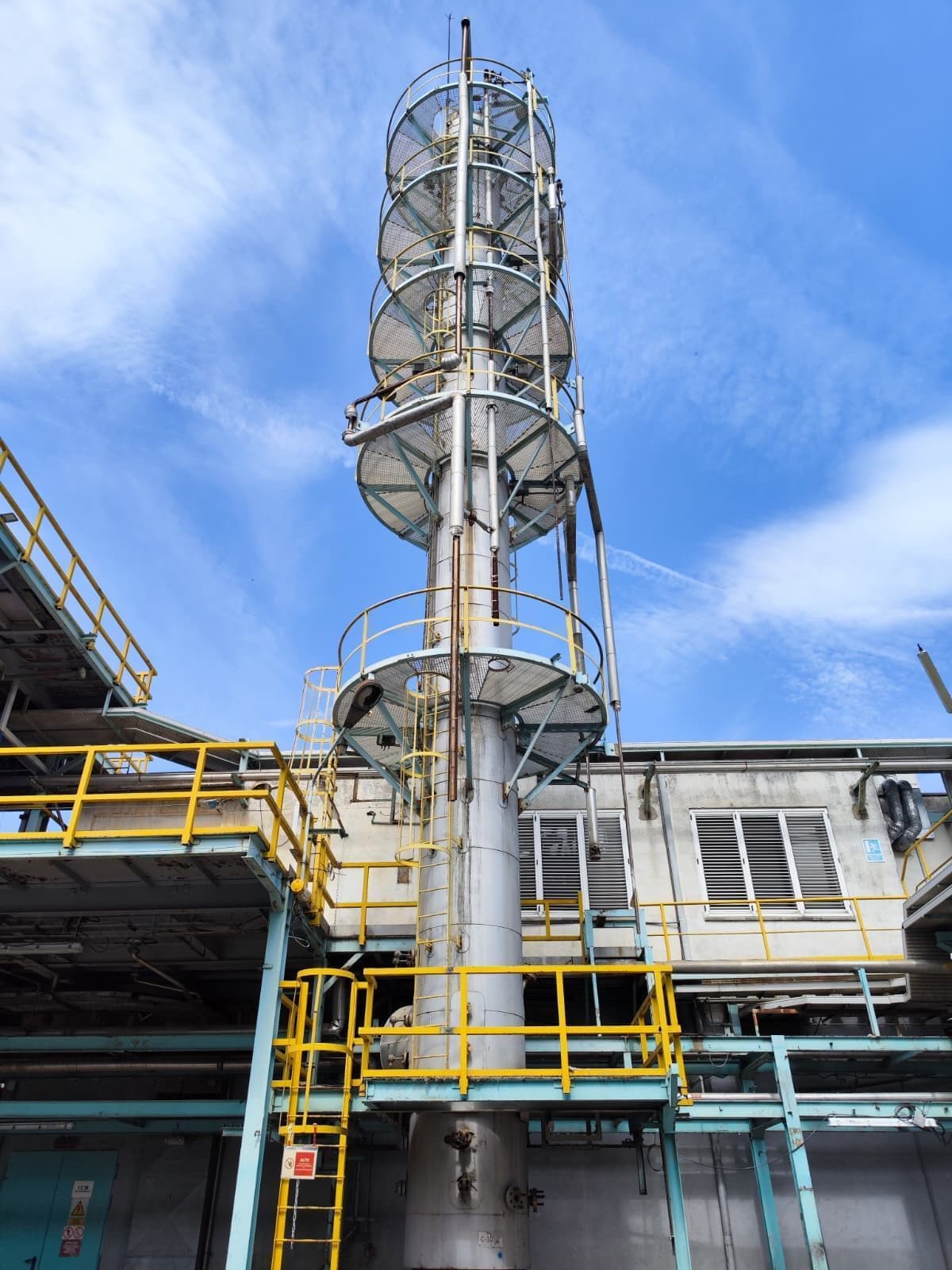
| Distillation column | Chemicals (ATEX zone) | 30 m high, 5 days | 100% |
| Food production plant | Food | 15 m high, 15 days, alongside live production | 95% |
| RTG port cranes | Ports | Two 25 m cranes, 10 days, live port | 100% |
We work in 12 industrial sectors, from chemicals and pharmaceuticals to automotive and construction, with ISO 9001, 14001 and 45001 certification.
Frequently asked questions
How long does an industrial demolition take in the Barcelona area?
It depends on the size, the structure and what has to be removed first. On our reference projects the work itself has taken between 5 and 15 days, but you have to add the time needed for municipal approval, which varies from one council to another and is best started as early as possible.
Do you work outside Barcelona?
Yes. From Castellbisbal, La Llagosta and Constantí we cover Catalonia, the Valencian Community and Aragon directly. For jobs in the rest of mainland Spain, we assess each case individually.
Who removes the asbestos if the building contains it?
A company registered on the RERA, with a work plan approved by the labour authority, and always before the demolition starts. That’s why the preliminary survey must identify any suspect materials: that way the site programme allows for their removal from the outset.
How quickly do you reply to an enquiry?
We reply within 48 working hours. Before we can finalise the quote, we need to carry out a site survey of the facility.
If you have an industrial building or plant to dismantle in or around Barcelona, the first step is that survey: it will tell you which permits you need, what materials are there and how much the recoverable ones are worth.