Contents
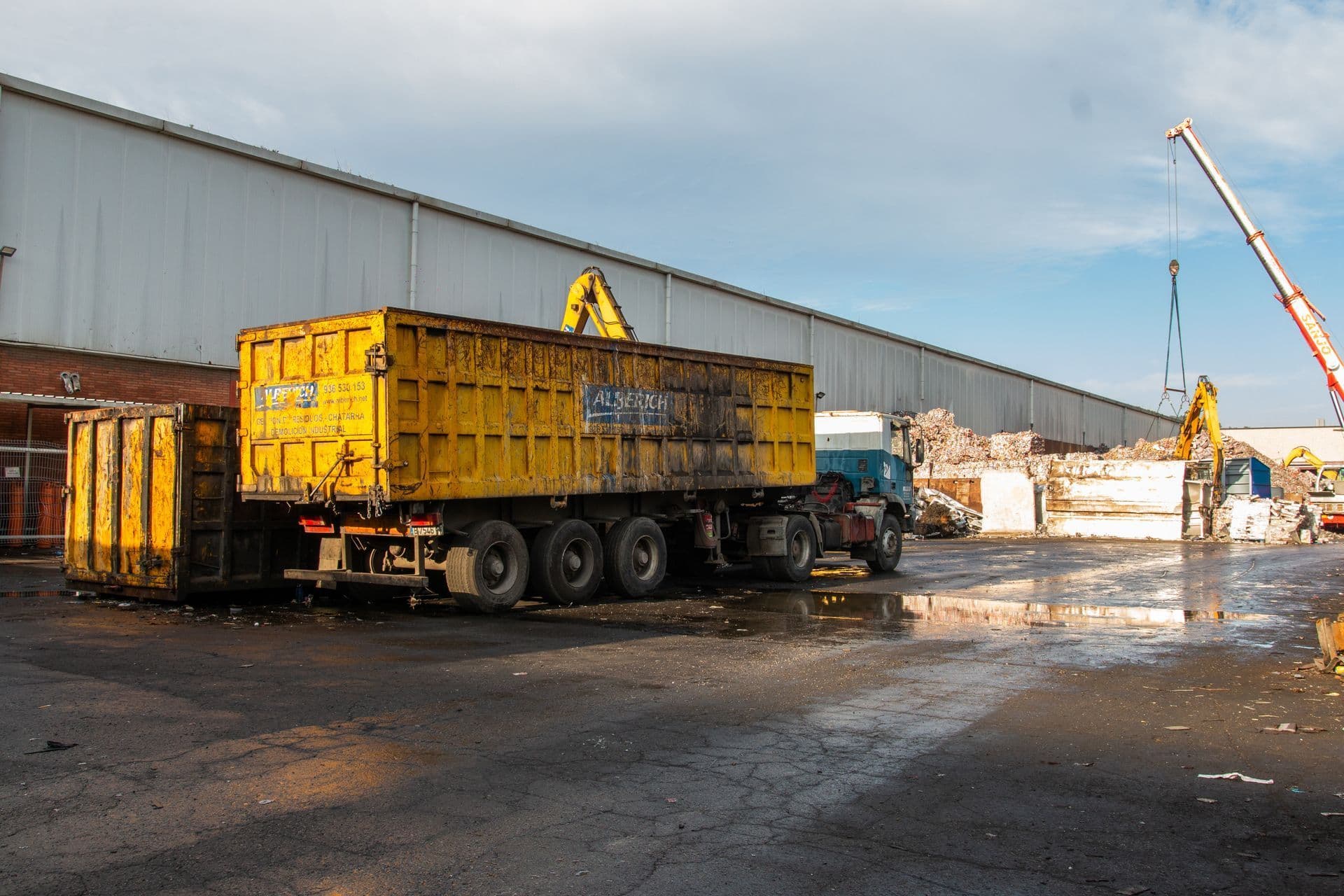
We place scrap metal containers from 1 to 30 m³ to suit your volume and pace. Light offcuts fill the space before the lorry reaches its weight limit. Dense scrap hits the weight limit with the container half full. If there’s a lot of air, a mobile baler cuts the number of trips.
The right container for you leaves full of metal, within the lorry’s weight limit, and with only one material inside. If you always order 30 m³, fine offcuts travel full of air. If you always order the small one, heavy scrap needs more trips.
We work with containers from 1 to 30 m³ and our own fleet. Size is set by volume and pace. The standards for chain-lift (skip) containers cover 5 to 10 m³ (DIN 30720-1) and 15 and 20 m³ (DIN 30720-2). Consulted on 5 November 2026. Our range covers those volumes and goes up to 30 m³.
Why doesn’t a cubic metre of scrap always weigh the same?
A cubic metre measures space. A lorry is limited by mass. A cubic metre of loose cans and a cubic metre of engines are not the same load. The figures below are orders of magnitude, taken from public US tables and converted from pounds. They are not weights from our weighbridge.
The EPA (April 2016) gives about 27 kg/m³ for uncompacted aluminium cans and about 130 kg/m³ for ferrous metal from building sites. ReMA (January 2026) puts shredded scrap at about 800 or about 1,120 kg/m³, and No. 1 and No. 2 bundles at no less than about 1,200 kg/m³.
A 30 m³ container of loose cans holds around 800 kg of metal. The same container at 800 kg/m³ would weigh about 24 tonnes in scrap alone. At 1,000 kg/m³, 30 tonnes.
Spain’s General Vehicle Regulations (Annex IX, consulted on 5 November 2026) set the maximum authorised mass of a three-axle rigid lorry at 25 tonnes, or 26 with twin tyres and air suspension. With four axles the cap is 31 tonnes, or 32 in the case set out in the annex. That is the mass of the whole vehicle, including the lorry’s own weight. A half-empty container of dense scrap can already be at the limit. A full one of loose cans doesn’t come close.
We plan every load to carry as much material as possible in as few trips as possible, within the vehicle’s permitted weight.
At Castellbisbal, complex scrap goes through a 4,000 hp shredder. Shredded scrap above one tonne per cubic metre is 211. Below that, it is 210. The container doesn’t have to arrive at that density. It does have to arrive in a state we can sort.
Which container suits each material?
There is one range: 1 to 30 m³. The rows below aren’t fixed orders: they show how to choose within that range. The details of the service are under scrap collection.
| Material | What fills up first | How to order it, from 1 to 30 m³ | Don’t mix it with |
|---|---|---|---|
| Fine offcuts, sheet, dry turnings | Volume: lots of air, little metal | The top of the range, or a mobile baler if the flow is continuous | Heavy ferrous, copper and cable |
| Sections, engines, castings | The lorry’s legal weight limit | Whichever container the vehicle can carry; a 30 m³ one isn’t always filled | Non-ferrous metals and any liquid |
| Copper, brass, cable, high-value aluminium | Neither the space nor the weight: the value of the lot | A separate container from the lower end of the range | Ferrous scrap |
| Loose aluminium cans and extrusions | Volume | A large container or a baler: loose, they weigh very little per m³ | Iron, plastics and rubbish |
| Metal with oil, cutting fluid or a hazardous fraction | The risk of spills | A leak-proof, covered container, not the one for clean scrap | All other scrap |
Copper is the clearest case. It isn’t separated out during melting and it builds up in new steel. Steel mills pay more for scrap with less copper. A cable in the ferrous container doesn’t ‘add’ anything: it contaminates the lot. The same goes for brass and high-value aluminium. They go separately so they can be weighed and sorted on their own. The list of what we buy is under what we buy, and the route for ferrous scrap under ferrous metals.
Spain’s Law 7/2022 on waste and contaminated soils (Article 21, consulted on 5 November 2026) requires an identified storage area. Non-hazardous waste going for recovery cannot be kept where it is produced for two years or more. If it is going for disposal, the limit is one year. For hazardous waste, it is six months, which only the authorities can extend by a further six. The clock starts from the first deposit, and that date must be shown on the container. Non-hazardous waste must not be mixed if that makes it harder to recover. Mixing to make waste less hazardous is prohibited.
If the metal comes with oil or cutting fluid, tell us beforehand. We arrange ADR-approved leak-proof containers, tankers, bulk bags and palletised loads. For hazardous waste, the documentation names the authorised final treatment facility. Transport is carried out under ADR when the rules require it. Not all hazardous waste requires ADR, and not everything carried under ADR is hazardous waste. If it isn’t metal, the service is waste management, where we act as a waste broker.
Codes and storage are covered in metal waste management. This article is about deciding the size.
Mobile baler or bigger container: when does each pay off?
Three levers. They aren’t mutually exclusive.
| Lever | When it makes sense | What changes in the yard |
|---|---|---|
| Bigger container | The material is light and you have room to manoeuvre | Fewer collection requests; each trip still carries air if you don’t compact |
| More frequent collections | The material is heavy or the yard can’t take a large container | The lorry leaves within its weight limit and scrap doesn’t pile up |
| Mobile baler | There’s a lot of empty space: offcuts, sheet, cans | Fewer trips for the same amount of metal |
The mobile baler bales and compacts at your premises. It helps when the problem is air, not when the problem is weight. An engine doesn’t need baling to fit: it needs a lorry that can take its mass. Cans and fine offcuts do.
At our plant, balers compact stamping offcuts into bundles of 300×300 to 400×400 mm. That is the output format at the plant. It isn’t the bundle size to expect from the baler at your premises.
Collection is weekly, fortnightly, monthly or on demand, so the container doesn’t turn into a storeroom. If you produce small amounts in occasional batches, on-demand collection is enough. If your line never stops, a fixed frequency keeps scrap from piling up on the floor.
Sometimes the vehicle matters more than the cubic metres. The fleet includes hook-lift and skip loader lorries, flatbed lorries with crane and grab, articulated lorries and low-loaders for very heavy items. Anything that doesn’t fit in the container is loaded by crane and grab. A whole machine goes on a low-loader. All vehicles are GPS-tracked.
What do you need to have ready before asking for a size?
With this information we’ll propose a container, a frequency and a vehicle. You don’t need a floor plan of your building.
- Material
What it is, the approximate grade and whether it comes mixed or already sorted. A photo of each fraction helps. - Quantity and pace
Approximate volume or weight, and whether it’s a one-off or recurring collection. - Location
Where it is and what format it’s in: loose, in a container, palletised or baled. - Access
Whether the lorry can manoeuvre and whether there’s a height or weight limit on the industrial estate. That’s what we check on the site visit or in the photos. - Start date
The date of the first deposit in the container: Law 7/2022 requires it to be recorded, because the storage period runs from that day.
You can bring the material to one of our sites or ask for our fleet to collect it. If you’re dropping it off yourself, opening hours are Monday to Friday, 08:00–13:00 and 14:00–17:00. Collection from your plant is arranged separately: route times aren’t the same as counter hours.
If you’re a private individual, we don’t leave a container at your home. The vehicle is handed in at a Scrap Center site, either under your own steam or by tow truck. There are eight of them, including Rubí and Les Franqueses del Vallès. A company in the Vallès doesn’t need to rely on that site: collections from your plant go out from Castellbisbal, La Llagosta and Constantí. From those three sites we cover Catalonia. Outside Catalonia, each job is looked at case by case.
What happens once the container leaves your plant?
At the site, every load is weighed on a trade-approved weighbridge, with a ticket showing gross, tare and net weight. All material undergoes radiation monitoring on the way in and on the way out. The lorry then goes to the area for its material. Each grade is inspected for contaminants and hazardous items mixed in, such as a battery in the scrap. That’s why batteries don’t go in the iron container. Before any processing, the first step is documentary traceability, along with checks for radioactivity and flammables.
Before it leaves, every waste shipment within Spain needs a treatment contract with the receiving facility. It travels with an identification document (DI). This is set out in Royal Decree 553/2020. Prior notification is submitted at least ten days in advance. It is mandatory if the waste is hazardous, if it is going for disposal, or if it is mixed municipal waste (EWC code 20 03 01 in the European List of Waste) going for recovery. In Catalonia, the DI is generated in the SDR (Sistema Documental de Residus), the online documentation system of the Catalan Waste Agency (ARC).
Depending on the material, we give you the waste acceptance form, the waste tracking sheet and the delivery note. If you ask for it, a certificate of destruction too. ‘Waste tracking sheet’ is the industry name: the legal name for the document that travels with the waste is the DI. The risks of moving waste without that document are covered in waste transport.
We are an authorised waste management company, authorisation no. E-345.97 from the Catalan Waste Agency. The scrap we buy comes in through this logistics operation. Anything that isn’t metal and goes to a final treatment facility, we coordinate as a waste broker. The documentation for hazardous waste names that facility.
Frequently asked questions
Does a 30 m³ container always hold more scrap?
No. It holds more volume. With loose cans, 30 m³ can mean something in the order of 800 kg of metal. With dense scrap, the lorry reaches its maximum authorised mass with the container half full.
Can I put copper in with the iron to make a single trip?
No. Copper stays in the new steel, and the ferrous lot is worth less if it’s contaminated. Copper, brass, cable and aluminium go in their own container.
Does the mobile baler replace the container?
No. It compacts offcuts, sheet and cans, which would otherwise travel full of air. With engines or castings the limit is weight, and the baler doesn’t change that.
What information do you need to suggest a size?
The material and whether it’s mixed, the quantity, whether it’s a one-off or recurring, where it is and the format. We’ll reply within 48 working hours.
If I’m a private individual, will you leave a container at my home?
No. The vehicle is handed in at a Scrap Center site; there’s no home collection. A company can have a container placed at its premises or bring the material to one of our sites.
Tell us what you generate, how much and how often, and send a photo of each fraction to info@alberich.net or through the contact form. We’ll reply within 48 working hours with the container and collection frequency that fit. Each lot is valued for what it is.
Sources cited
- DIN 30720-1dinmedia.de
- DIN 30720-2dinmedia.de
- General Vehicle Regulationsboe.es
- Law 7/2022boe.es
- Royal Decree 553/2020boe.es