Metal alloys are mixtures of a base metal with other elements, metallic or not, that improve one or more of its properties: steel is iron with carbon, brass is copper with zinc and bronze is copper with tin. Industry mainly uses steels, stainless steels, aluminium alloys and copper alloys. At the end of their service life all of them can be recycled, but they only keep their value if they are properly separated, because a wrongly sorted alloy spoils the melt it ends up in.
What is a metal alloy and what is it for?
Pure metals rarely have every property an application calls for. Pure iron is soft; pure aluminium is not strong enough for a structure; pure copper is an excellent conductor but wears quickly. Adding other elements in the right proportion produces a material made to measure.
Metal alloys make it possible to fine-tune hardness and mechanical strength, corrosion behaviour, conductivity, weight, melting point or castability. Small amounts make a big difference: a few tenths of a per cent of carbon separate a mild steel from a tool steel, and around 2% molybdenum turns an ordinary stainless steel into one suitable for the chemical industry.
What types of alloy are there?
The most useful classification, for recycling as well, distinguishes two broad families:
- Ferrous alloys: based on iron. They include carbon steels, alloy steels, stainless steels and cast irons.
- Non-ferrous alloys: based on another metal, such as aluminium, copper, zinc, nickel or titanium.
If you want to look at this difference in more detail, we explain it in the guide to ferrous and non-ferrous metals. Within each family there is another important distinction: wrought alloys, designed to be rolled, extruded or forged, and casting alloys, designed to be cast in moulds. Even when they share a base metal, their composition is different.
What are the most common metal alloys in industry?
| Alloy | Base and main alloying elements | What it provides | Common uses |
|---|---|---|---|
| Carbon steel | Iron with less than 2% carbon | Strength, weldability, low cost | Structures, machinery, automotive |
| Cast iron | Iron with more than 2% carbon, plus silicon | Good castability, damps vibration | Machine beds, engine blocks, pipes, castings |
| Stainless steel | Iron with at least 10.5% chromium, plus nickel or molybdenum depending on the series | Corrosion resistance | Food, chemical and pharmaceutical industries |
| Aluminium alloys | Aluminium with magnesium, silicon, copper, zinc or manganese | Lightness and corrosion resistance | Extrusions, cans, alloy wheels, sumps, aerospace |
| Brass | Copper with zinc | Machinability, corrosion resistance, finish | Taps, valves, electrical terminals |
| Bronze | Copper with tin (sometimes with a little phosphorus), or with aluminium or silicon | Hardness, wear resistance, seawater resistance | Bearings, gears, propellers |
| Zamak | Zinc with around 4% aluminium, plus magnesium and copper | Die-casting of precision parts | Taps, fittings, handles |
| Nickel and titanium alloys | Nickel with chromium; titanium with aluminium and vanadium | Resistance to high temperatures, or high strength at low weight | Turbines, aerospace, chemical industry |
Steels and stainless steels
Steel is by far the most widely produced alloy in the world. Among stainless steels, the 300 series (austenitic, with chromium and nickel) is the most common: 304 contains around 18% chromium and 8% nickel, and 316 adds molybdenum to resist chlorides. The 400 series (ferritic and martensitic) is magnetic and contains almost no nickel, and the 200 series replaces part of the nickel with manganese. For a recycler, these are different materials: 304 and 316 are not worth the same and do not go to the same destination. We explain this on our stainless steel page.
Aluminium alloys
Wrought alloys are grouped into series according to their main alloying element. The 6000 series (aluminium with magnesium and silicon) is used for window and façade extrusions; beverage can bodies are 3000 series and the lids 5000 series. Casting alloys, which are rich in silicon, go into alloy wheels, sumps and engine parts. That is why, in recycling, aluminium is separated into extrusions, cans, wheels and cast aluminium.
Copper alloys
Brass and bronze are the best known, but not the only ones: cupronickels, made of copper and nickel, are used in coins and seawater piping. You will find the differences between brass and bronze in brass vs bronze: differences and uses, and those between bronze and copper in copper and bronze.
Why do alloys need to be properly separated for recycling?
Because each alloy goes back into a furnace that produces a specific composition, and some elements cannot be removed once they have been melted. The clearest example is copper in steel: it does not separate out during melting, it builds up in the new steel and impairs its mechanical properties. That is why steel mills pay more for scrap with less residual copper.
| Mix | What problem it causes |
|---|---|
| Copper or tin in steel scrap | Residual elements that do not come out during melting and limit the quality of the steel |
| 316 stainless mixed with 304 | The added value of the molybdenum, which makes 316 worth more, is lost |
| Wrought aluminium with cast aluminium | Silicon outside the specification for remelting into extrusions or sheet |
| Brass with bronze | The foundry has to regrade the material or adjust the composition |
| Iron inside aluminium or brass parts | It contaminates the melt and has to be removed first |
For the waste producer, the consequence is simple: a mixed lot is valued as a mix. Separating at source, even if only into broad families, raises the value of the material.
How are alloys identified and separated in a plant?
A recycling plant combines several technologies, each handling one type of separation:
- Magnet: separates ferrous material (steel, cast iron, 400 series stainless) from non-ferrous.
- Eddy current separators: eject non-ferrous metals from a stream of shredded material.
- X-ray and colour sorting: distinguish metals by composition and by colour, for example red metals (copper and brass) from aluminium.
- Density: separates light and heavy metals, or metal from plastic.
- Spectrometry: confirms the exact alloy when the grading calls for it, as with stainless steel or copper.
How does Alberich handle metal alloys?
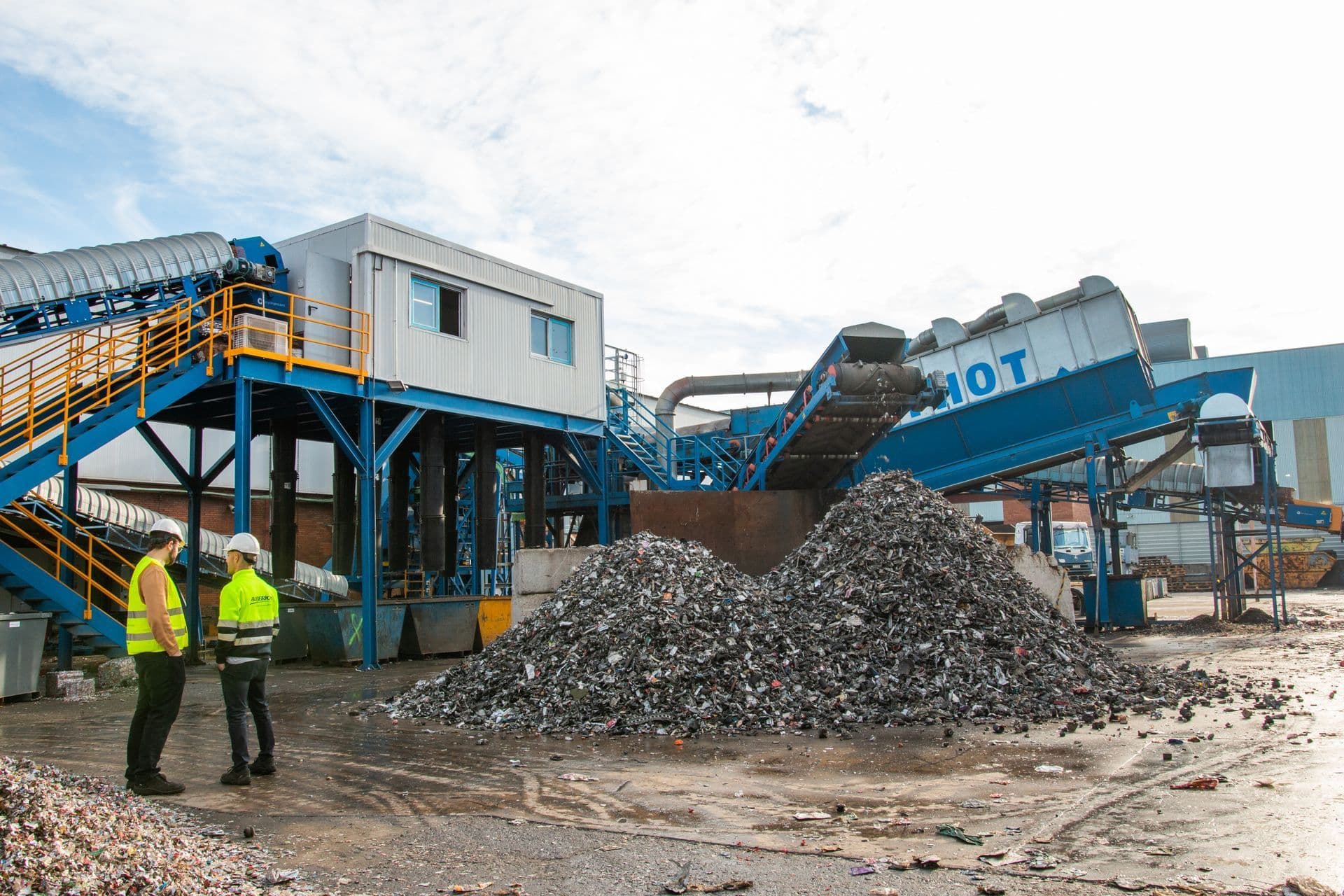
At Castellbisbal, the 4,000 hp shredder breaks down complex scrap and separates out the ferrous fraction; the post-shredder separation line then sorts the non-ferrous material using eddy current, induction, X-ray and colour sorting. This produces grades such as Zorba, an aluminium-rich non-ferrous mix, and the red metals fraction.
Material that arrives clean does not need that process: it is sorted by alloy from the moment it is received. We buy and separate 304, 316 and special stainless alloys; aluminium as extrusions, cans, wheels and sumps; copper by grade; brass, bronze and zamak; and lead and zinc. We also turn part of the aluminium into secondary aluminium. All material undergoes radiation monitoring on arrival and departure, and we are certified to ISO 9001, 14001 and 45001. You will find the details by family on our metals page and the materials we buy in what we buy.
Frequently asked questions
What is the most widely used metal alloy?
Steel, by a very wide margin. Aluminium alloys and copper alloys come next, but they are produced in much smaller volumes.
Do alloys lose their properties when recycled?
Not if they are properly sorted before recycling. Metals do not degrade when they are remelted; what can happen is that a mix of alloys produces an off-spec composition, which is why separation matters so much.
What is zamak?
It is a zinc alloy with a small percentage of aluminium, magnesium and copper, used to die-cast precision parts such as taps, handles and fittings. It often has a chrome or gold-coloured finish that makes it look like brass, but it is considerably lighter.
Can a part that combines several alloys be recycled?
Yes. If it can be dismantled, it is best to separate the parts before handing it in. If not, the part goes through the shredder and the separation lines, which recover each metal separately.
If you generate scrap containing different alloys and want to know how to separate it to get the most value from it, tell us what materials you have.


