To scrap a car in Spain, or any other used vehicle, you have to take it to an authorised treatment facility (ATF) with your valid Spanish ID card (DNI) or foreigner ID number (NIE), the deregistration request and the signed certificate of destruction. The facility deregisters the vehicle permanently with the DGT (Spain’s traffic authority) and sends you the certificate of destruction. At Alberich, if you’re a private individual, you bring the car to one of our Scrap Center sites, get paid on the spot and have the deregistration and the certificate within 5 working days.
This guide covers cars, vans, motorcycles, commercial vehicles and written-off vehicles, and explains what changes if you’re a company. If you’d like to know what can be recovered from an old car and why it has to go through an authorised facility, we cover that in car recycling: what gets recycled from your old vehicle.
Why do you need to deregister a vehicle you no longer use?
As long as the vehicle is still registered with the DGT, you remain its registered keeper for all purposes: you pay vehicle tax, you have to keep the compulsory insurance in place and you’re liable for whatever happens to it, even if it has been sitting in a garage or on a plot of land for years.
Only an ATF can carry out permanent deregistration for scrapping, because it is the facility that issues the certificate of destruction. Royal Decree (RD) 265/2021 on end-of-life vehicles makes it compulsory to hand them over to one of these facilities, which must also depollute them before treating them. Oils, fuel, coolant, air-conditioning gases and batteries must not end up in the ground or in water.
What documents do you need to scrap a vehicle?
In the most common case, a private individual handing in their own car, three documents are enough:
- Deregistration request, on the form the facility gives you.
- Certificate of destruction, signed by the registered keeper or their representative. The facility completes it after processing the deregistration.
- Valid DNI, NIE or passport of the registered keeper. If it has expired, the deregistration can’t be processed.
Bring the vehicle registration certificate and the technical data sheet too, if you have them. For other situations, this is what you need to add:
| Situation | What you need to add |
|---|---|
| You’ve lost the vehicle registration certificate or the technical data sheet | Declaration of loss |
| Someone else is handing in the vehicle on the registered keeper’s behalf | Letter of authorisation signed by the registered keeper, the keeper’s DNI and the representative’s DNI |
| The registered keeper has died | Signed declaration (declaración responsable), death certificate and the DNI of the person signing the declaration |
| The registered keeper is a company | Proof of authority to act for the company and the DNI of the person representing it |
The rule is the same for everyone: if a document is missing or isn’t valid, the vehicle can’t be accepted. Check the expiry date on your DNI before you leave home: with an expired document, the paperwork can’t be completed.
How do you scrap a car in Spain, step by step?
- Get in touch first. Call us, write to us or ask at the site. We’ll confirm which documents you need in your case and how to deliver the vehicle.
- Drop-off. Private individuals bring the vehicle to a Scrap Center site themselves or by tow truck. Companies can bring it in or ask us to collect it.
- Reception. We check the registration number and the VIN (chassis number), review the paperwork and weigh the vehicle on a trade-approved weighbridge. Each vehicle gets its own case file, opened under its VIN.
- Valuation and payment. The vehicle is valued on its weight and its suitability for recovery. As a private individual, you’re paid on the spot at a payment kiosk using the barcode on the delivery note.
- DGT deregistration and certificates. We check that the vehicle can be deregistered, process the deregistration online and send you the certificate of destruction and the proof of deregistration within 5 working days. Urgent cases are given priority.
You don’t have to go to any DGT office. The proof of deregistration is the document that shows the vehicle is no longer in your name: keep it safe.
Where can you drop off your car as a private individual?
At any of the eight sites in Alberich’s Scrap Center network. We don’t offer home collection for private individuals, so you’ll need to bring the vehicle yourself or by tow truck.
| Scrap Center | Address |
|---|---|
| Badalona | C/ Tortosa, 205 |
| L’Hospitalet de Llobregat | C/ Metal·lúrgia, 11 |
| Rubí | Passeig de les Torres, 65 |
| Les Franqueses del Vallès | C/ Àustria, 12 · Pol. Ind. Pla de Llerona |
| Vilanova i la Geltrú | C/ Eusebi Millan, 29 |
| Igualada | C/ Itàlia, 24 |
| El Vendrell | C/ Poliol, 9 |
| Malgrat de Mar | C/ Estany, 25 |
Before you go, check the opening hours of your nearest site on our contact page.
What changes if the vehicle belongs to a company or a fleet?
The DGT procedure is the same, but logistics and payment work differently:
| Aspect | Private individuals | Companies |
|---|---|---|
| Drop-off | At a Scrap Center site, themselves or by tow truck | Bring the vehicles in or book a collection with our car transporters |
| Reception | Vehicle by vehicle | In batches, with the VIN of each unit checked |
| Valuation | By weight and suitability for recovery | Under the trade account terms: volume, frequency and logistics |
| Payment | Immediate, at the kiosk, with the delivery note barcode | Periodic invoicing under the trade account |
| Deregistration and certificate | 5 working days | 5 working days |
We often work with whole fleets, vehicle registration agents and dealerships. The first time, the company is set up as a supplier and, from then on, the paperwork for each batch is handled centrally.
What happens to the vehicle after deregistration?
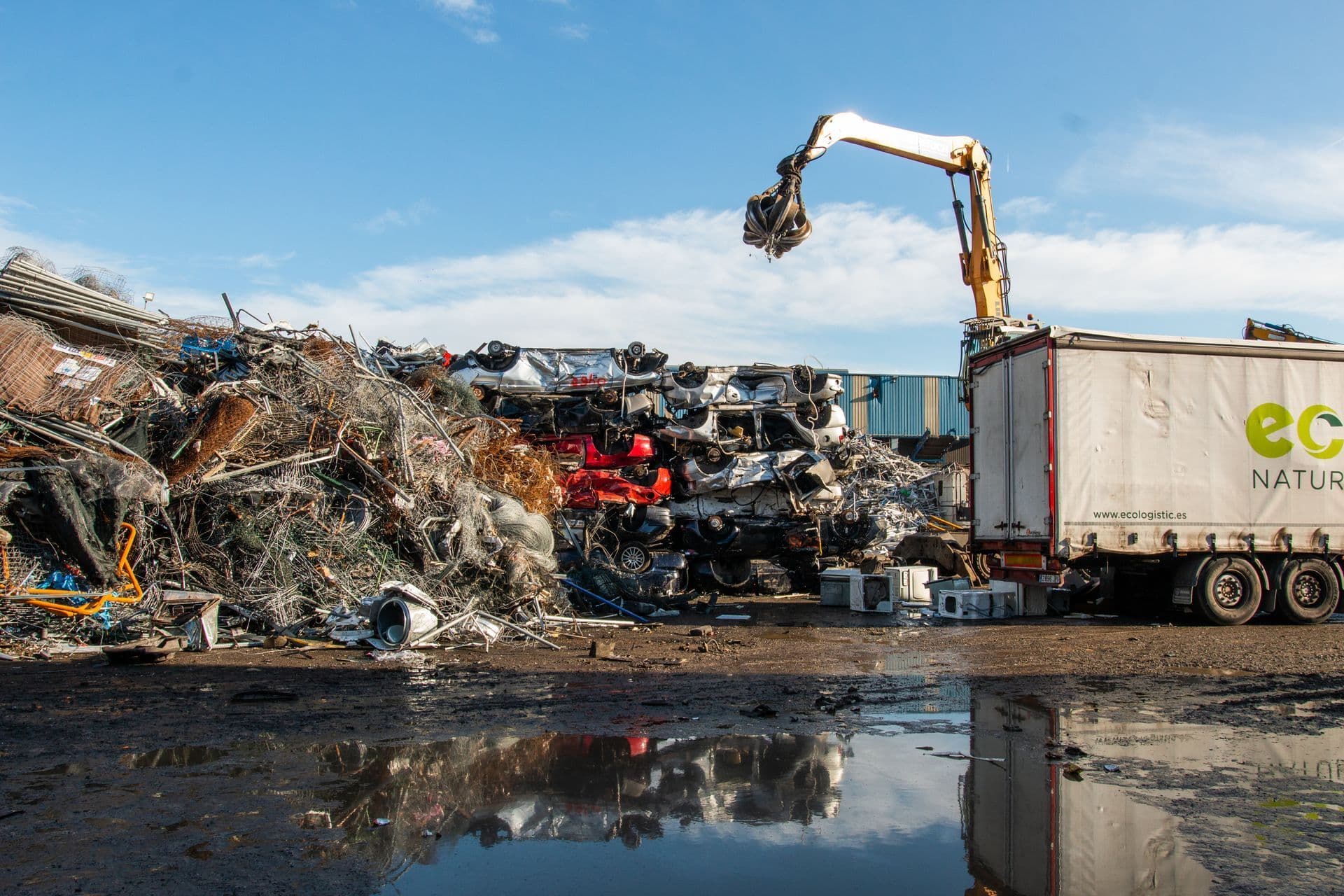
No vehicle goes into the shredder until it has been depolluted. First the battery, oils, fuel, coolant, air-conditioning gases and other fluids are removed. In hybrid and electric vehicles, the traction battery is also taken out and handed over to an authorised waste management company, with traceability by VIN.
Then the body shell goes through the 4,000 hp shredder at Castellbisbal. The steel comes out as shredded scrap for steel mills, and non-ferrous metals such as aluminium and copper are separated out in the post-shredder separation line. Each vehicle’s case file is closed with all its paperwork. If you want the details, we explain which materials are recovered from a car and where each one goes.
Frequently asked questions
What if the car won’t start or has no valid ITV (Spain’s MOT)?
It doesn’t have to run. To be driven to the site it needs a valid ITV and insurance, like any other vehicle; if it doesn’t have them or won’t start, bring it on a tow truck. What is essential, though, is that the VIN is legible.
Can I get some of my road tax back?
Vehicle tax (impuesto sobre vehículos de tracción mecánica, Spain’s municipal road tax) is calculated pro rata by calendar quarter when a vehicle is permanently deregistered. If you had already paid for the whole year, you can ask your town council to refund the quarters after the deregistration. Each council has its own procedure and will usually ask for the proof of deregistration.
What should I do about insurance after deregistration?
Tell your insurer about the deregistration, sending the DGT proof of deregistration or the certificate of destruction, so that the policy can be cancelled. Ask whether you’re entitled to a refund of the unused part of the premium.
Do you accept written-off, fire-damaged or flood-damaged vehicles?
Yes, as long as the VIN is legible and the vehicle can be identified. Written-off vehicles need more care during depollution, because fluids or components may be damaged, and each case is assessed on arrival.
Do you sell second-hand parts?
No. Alberich doesn’t sell spare parts. The vehicles we receive are depolluted and recycled for their materials.
If your paperwork is ready, the next step is to choose your nearest Scrap Center. If you manage a fleet, tell us how many vehicles there are and where they are: we’ll arrange the collection and reply within 48 working hours. You’ll find all the information about the service under end-of-life vehicles.