Electrical transformer recycling and disposal start with identifying the type of unit being taken out of service (oil-filled without PCBs, oil-filled with PCBs, or dry-type) and confirming by laboratory analysis whether its oil contains PCBs. The transformer is then removed with the appropriate waste documentation and handed over to an authorised waste management company, which decontaminates it and recovers the copper, the steel and, where possible, the oil. If PCBs are present, final destruction can only be carried out by an authorised final treatment facility.
What types of transformer are there, and how is each one handled?
| Type | What it contains | How it is handled |
|---|---|---|
| Oil-filled, without PCBs | Dielectric oil free of chlorinated compounds; copper windings | Controlled oil draining, cleaning and dismantling; the copper, steel and oil are recovered |
| Oil-filled, with PCBs | Oil containing polychlorinated biphenyls (piraleno) above the legal threshold | Hazardous waste with specific documentation; destruction is carried out by an authorised final treatment facility |
| Dry-type | Resin-encapsulated windings, no oil; copper or aluminium | No draining: the windings are removed and separated by metal, and the steel in the core is recovered |
Oil-filled units without PCBs are the most common and have the most recoverable value. Units with PCBs call for the most care, which is why everything starts with finding out whether they contain them.
How can you tell whether a transformer contains PCBs?
PCBs (polychlorinated biphenyls), known in Spain by the trade name piraleno, were used for decades as dielectric oil because of their thermal stability. Their toxicity, their persistence in the environment and their ability to build up in living organisms led to them being banned, and today equipment containing them is handled as hazardous waste.
There are three clues and only one test:
- The year of manufacture. Transformers made before 1986 are treated as suspect.
- The rating plate. Names such as Askarel, Piraleno or Clophen indicate oil containing PCBs.
- The unit’s history. A unit manufactured without PCBs may have been contaminated if it was ever topped up with oil from another unit that did contain them.
- Laboratory analysis of an oil sample, which is the only way to confirm whether PCBs are present and at what concentration.
Under the regulations, an oil is considered to contain PCBs when it exceeds 50 ppm (0.005% by weight). Above that threshold, the unit falls under the specific regime for PCBs.
What are the stages in disposing of a transformer?
| Stage | What happens |
|---|---|
| 1. Opening the case file | Unit details (type, rating, year, location and any signs of PCBs) and photos from the front and side to pre-classify it |
| 2. Analysis and valuation | Oil analysis where applicable, definition of the technical route and financial valuation |
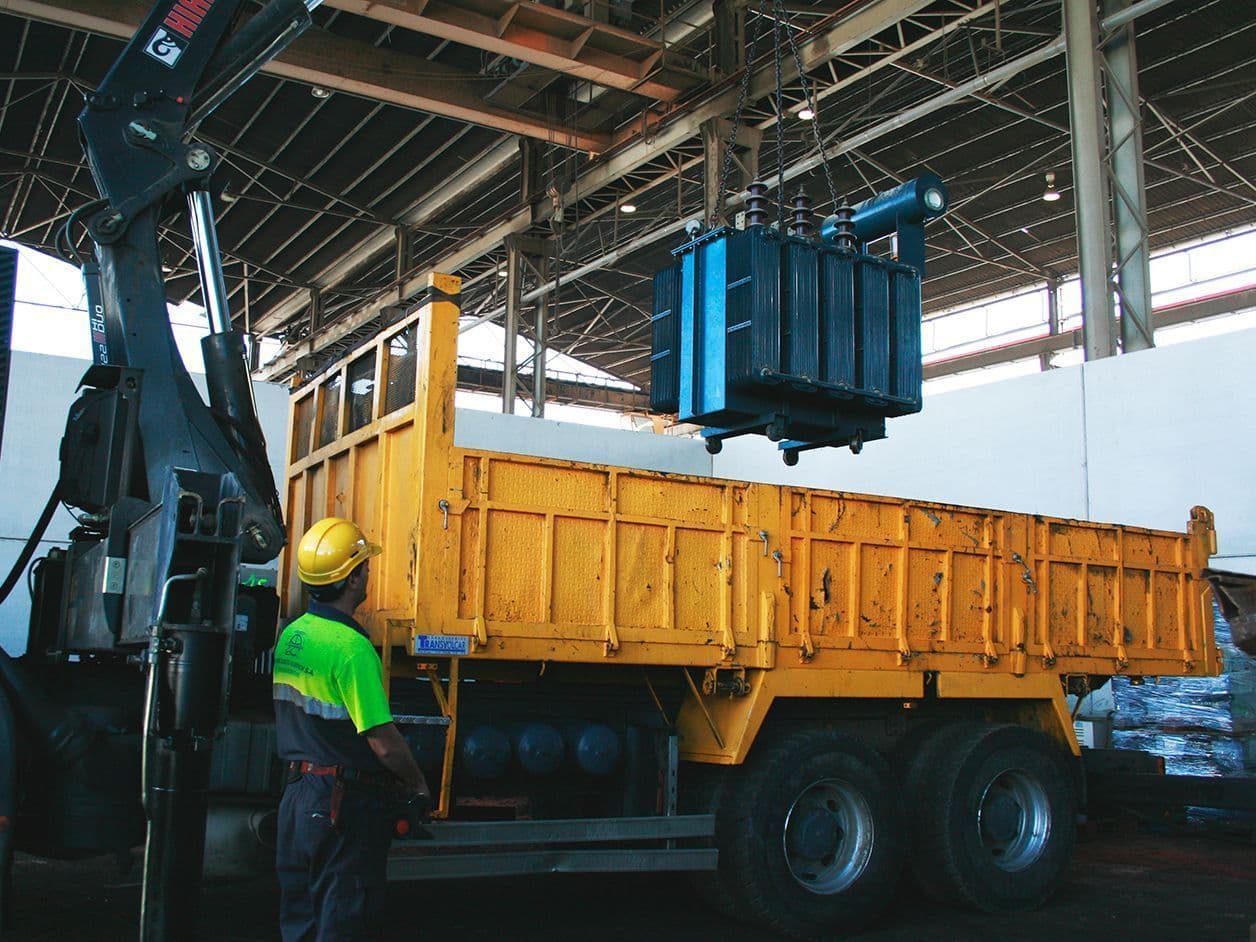
| 3. Removal and transport | Safe extraction, loading and transport, with vehicles authorised for hazardous waste where required |
| 4. Treatment at the plant | Controlled oil draining for oil-filled units without PCBs; direct removal of the windings from dry-type units; onward shipment to a final treatment facility for units with PCBs |
| 5. Dismantling and recovery | Separation of the copper or aluminium, the steel, the insulating materials and the ancillary parts |
| 6. Closing the case file | Handover of the documentation and, if requested, the certificate of destruction |
Before removal, the transformer must be disconnected and de-energised. That operation is the responsibility of the installation owner or their electrical maintenance contractor, who applies the five golden rules: disconnect, prevent reconnection, verify that no voltage is present, earth and short-circuit, and mark off the work area. Once the unit is isolated, the extraction is prepared: lifting equipment, drip trays to catch any leaks and a vehicle suited to the weight.
What happens to the transformer oil?
Oil without PCBs
It is drained under controlled conditions and sent, with its waste tracking sheet, to an authorised waste oil management company for regeneration or recovery. Regeneration removes the water, acids and sludge that oil builds up over the years, by filtering and treatment with adsorbent clays, and restores its insulating properties. It is the best outcome for used oil, because the oil is used again instead of being burned.
Regeneration is also used on transformers in service, as maintenance to extend their working life. That is a decision for the unit’s owner and their maintenance contractor, and it is separate from handling the transformer as waste.
Oil with PCBs
It isn’t treated at our plant. For these units we act as a transfer station (T62): we receive the transformer, issue the paperwork and send it on to an authorised final treatment facility, which carries out the destruction. The usual techniques at those facilities are high-temperature incineration in furnaces designed for chlorinated compounds, and chemical dechlorination, which breaks down the PCB molecule. The final treatment facility appears on the documentation as responsible for the destruction.
What materials are recovered in electrical transformer recycling?
Once decontaminated, the transformer is dismantled and each fraction follows its own route:
| Material | Where it comes from | Where it goes |
|---|---|---|
| Copper | Windings of oil-filled units, which are always copper, and of some dry-type units | It is removed, sorted and sent to the copper line |
| Aluminium | Windings of some dry-type units | It is separated from the copper before recovery, because its destination and value are different |
| Silicon steel | Electrical steel laminations of the core | Steel-mill grade ferrous scrap |
| Steel | Tank and radiators | Ferrous scrap for steelworks |
| Ancillary parts | Insulators, bushings, tap changers, resins and insulating paper | The treatment route that applies to each fraction |
Depending on the design, copper can account for around a fifth of the weight of an oil-filled transformer, although the proportion varies widely with the rating, the manufacturer and the year. We break down what each component is worth, and what poor management adds to the cost, in how transformer recycling can save you money.
What documentation do you receive, and what is the certificate of destruction for?
| Document | What it is for | When it is issued |
|---|---|---|
| Initial data sheet | Unit details, location and preliminary risk classification | When the case file is opened |
| Oil analysis | Determines whether PCBs are present and at what concentration | Where applicable |
| Waste acceptance form | Accepts the waste before removal | Always; it is mandatory |
| Waste tracking sheet | Tracks the waste from your installation to the plant | Always; it is mandatory |
| Priced goods-received note | Records what was received at the plant and the valuation of the material | When the unit is received |
| Certificate of destruction | Certifies that the unit has been safely destroyed | Optional, on request |
The documents required by law are the waste acceptance form and the waste tracking sheet. Most case files don’t need a certificate of destruction: we issue one when the customer asks for it, for a fee, and it is usually used for environmental audits or to remove the unit from the regional inventory of PCB-containing equipment.
Why does it matter who handles it?
Because, as the producer of the waste, you are responsible for the transformer until its complete treatment has been documented, as laid down in Spain’s Law 7/2022 on waste and contaminated soils. If a unit containing PCBs ends up with someone who isn’t authorised and causes contamination, administrative liability, and in serious cases criminal liability, can extend to the original holder. Check that the waste management company is authorised for transformers, and insist on the waste acceptance form and the waste tracking sheet before the unit leaves your site.
How we do it at Alberich
The Catalan Waste Agency authorises us, under waste management authorisation no. E-345.97, to handle oil-filled and dry-type transformers: removal, transport, treatment at our plant, recovery and document management, with a single point of contact from start to finish. For units containing PCBs, we act as a transfer station (T62).
We work mainly in Catalonia from Castellbisbal, with our own fleet, which includes low-loaders for complete transformers, and we look at operations outside the region case by case. The copper from the windings goes to our copper line, and the steel joins the same processing stream that handles more than 300,000 tonnes of scrap every year. We hold ISO 9001, 14001 and 45001 certification.
Frequently asked questions
How long does the whole process take?
It depends on the size of the transformer, where it is and whether it contains PCBs. In standard cases, the process from opening the case file to closing it can be completed in a few weeks, and for urgent jobs, such as a replacement with a fixed date, we prioritise the paperwork.
Who carries out the oil analysis?
The customer usually provides it, because many installations already have one from their maintenance. If you don’t have one, we offer an oil sampling service.
What should I do if the transformer leaks oil before it is removed?
Contain the leak with a drip tray or absorbent material, stop it from reaching drains or unpaved ground, and let us know when you request the removal. Used absorbents are also waste that has to be managed, and if the oil contains PCBs they must be managed as hazardous waste.
Can you remove several transformers from the same site?
Yes. Tell us how many units there are when you open the case file: we pre-classify each one and plan the removal in one or more loads. Handling them together simplifies the paperwork and spreads the transport cost.
If you have transformers that are no longer in use, send us the type, the rating, the year of manufacture, the rating plate details and a few photos. We’ll reply within 48 working hours.