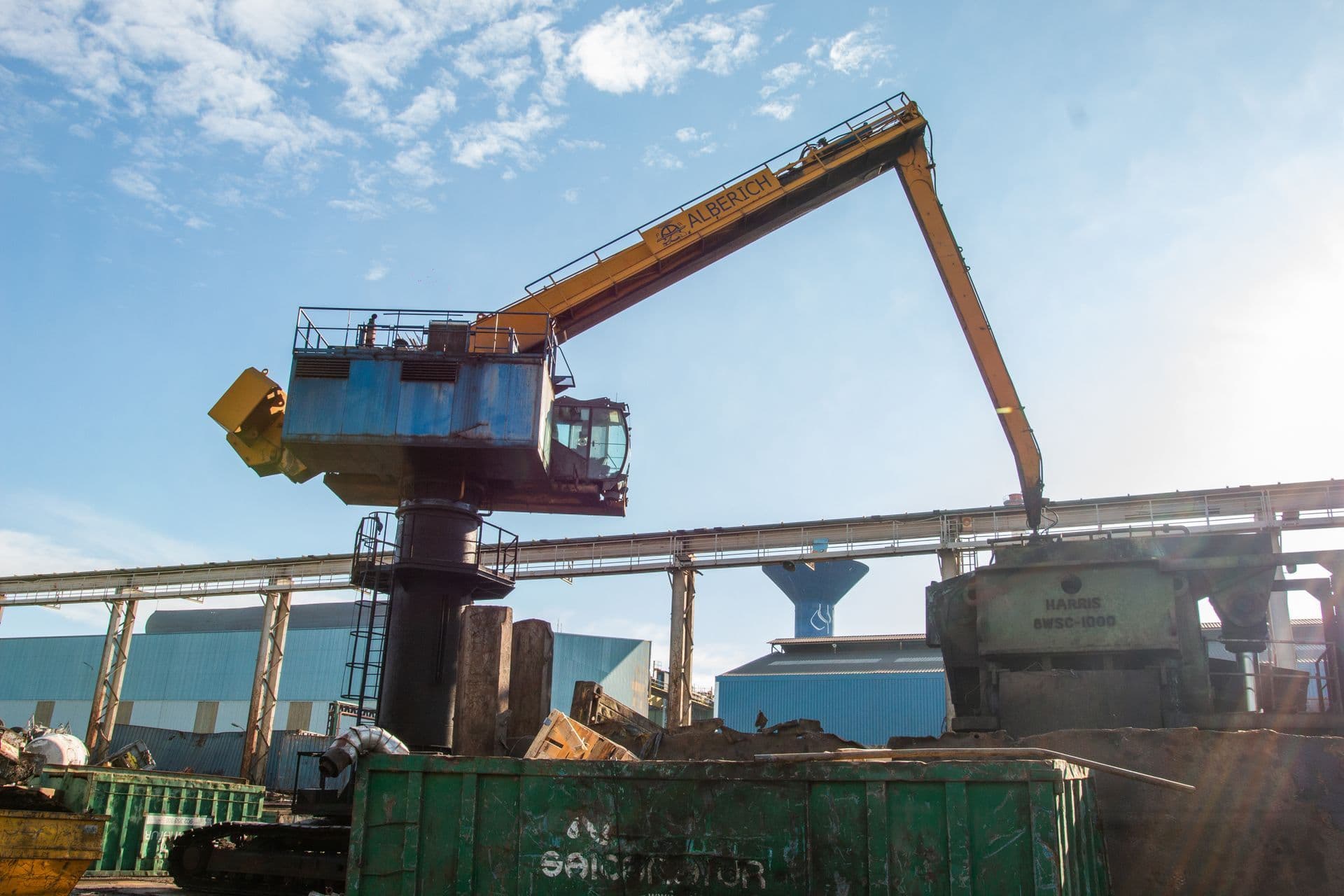
Recycling ferrous materials means turning iron and steel that are no longer in use into raw material for making new steel. Ferrous metal recycling always follows the same path: the scrap is collected already separated at source, weighed and checked on arrival at the plant, sorted into grades, prepared with a shear, baler or shredder depending on its type and, once checked, delivered to steel mills and foundries that melt it in electric furnaces.
This is what each step looks like at a plant like Alberich’s in Castellbisbal, and what you can do to make sure your scrap arrives in the best possible condition.
Which ferrous materials can be recycled?
Practically anything made of iron or steel: dismantled structures and industrial buildings, machinery and production lines, stamping offcuts, machining turnings, sheet, tube, end-of-life vehicles, household appliances, metal packaging and cast-iron parts. Steel can be remelted again and again without losing its properties, which is why scrap is such a sought-after raw material.
What changes from one material to another is the treatment it needs:
| Type of material | Examples | Usual treatment |
|---|---|---|
| Heavy and structural | Beams, sections, machine beds, machinery | Oxy-fuel cutting and shearing to steel-mill size |
| Light production scrap | Stamping and pressing offcuts, thin sheet | Baling into dense bundles |
| Complex or mixed | Vehicles, household appliances, scrap with contaminants | Shredder and magnetic separation |
| Low-residual | Clean, uniform industrial offcuts | Sorting and separate storage |
| Turnings | Swarf from turning and milling | Collected separately, drained of oil and cutting fluid |
What are the stages of ferrous metal recycling?
1. Separation and collection at source
Recycling starts where the scrap is generated. One container for iron and another for non-ferrous metals, with no wood, plastics or general rubbish, already makes a difference to the quality of the lot and to what you are paid for it. Alberich places containers from 1 to 30 m³ at the customer’s premises and collects them with its own fleet. If you generate a lot of light offcuts, we can also bale them on your premises with a mobile baler. You’ll find the details under logistics and collection.
2. Reception, weighing and radiation monitoring
On arrival at the plant, the lorry goes over the trade-approved weighbridge, which records the gross weight and the tare. The load passes through radiation monitoring, which detects any radioactive source that might be hidden in the scrap. A technician then inspects the material to identify contaminants or hazardous items and assigns it a grade.
3. Sorting into grades
Not all ferrous scrap is worth the same or goes to the same place. It is separated by thickness and density (heavy, medium or light), by origin (new production offcuts, or demolition and post-consumer scrap) and by its content of residual elements: copper, tin, chromium or nickel, which are not removed during melting. Each grade is stored separately. We explain the types and what determines their value in ferrous scrap: much more than waste.
4. Preparation: oxy-fuel cutting, shear, baler or shredder
The aim is for the scrap to reach the steel mill at the size and density the furnace needs. Depending on the material:
- Oxy-fuel cutting, for very large items or structures that won’t fit in the shear.
- Shear: Alberich’s shears cut beams, sections and heavy machinery to steel-mill size with a force of 600 to 1,000 tonnes.
- Baler: it compacts light pressing offcuts into bundles of 300 × 300 to 400 × 400 mm, which load and melt much better than loose sheet.
- Shredder: the 4,000 hp shredder in Castellbisbal breaks down vehicles, household appliances and mixed scrap; magnetic drums separate the steel from everything else.
5. Quality control and outbound radiation monitoring
Before loading, each lot is checked to make sure it meets the agreed grade. With shredded scrap, operatives hand-pick any remaining copper, cable or rubber off the conveyor, and density and size are checked. The load goes through radiation monitoring again on the way out, as a second safeguard for the steel mill.
6. Delivery to the steel mill and melting
The prepared scrap is shipped to steel mills and to grey and ductile iron foundries. At the steel mill it is melted in an electric arc furnace, its composition is adjusted and it is cast as new steel: rebar, sections, sheet or parts. That closes the loop: the steel from a dismantled industrial building can go back into construction.
Why is radiation monitoring so important?
Because a lost radioactive source, from old medical or industrial equipment for example, can end up mixed in with scrap. If it gets melted, it contaminates the steel, the furnace and the steel mill’s facilities, and the problem affects the whole chain. That’s why scrap is checked on its way into the plant and again before it leaves. If the detectors raise an alarm, the load is isolated and the relevant authorities are notified; they then say how the material must be handled.
What should you remove before delivering ferrous scrap?
Some items must not reach the shear or the shredder, for safety reasons or because they lower the quality of the lot. Before you fill the container, set aside:
- Sealed or pressurised containers: gas cylinders, fire extinguishers, unopened tanks. They can explode when cut or shredded.
- Liquids: oils, fuels and coolants. Equipment and tanks must arrive empty.
- Non-metallic materials: wood, plastics, rubble or excess soil.
- Copper and other non-ferrous metals: cable, motors, windings. They are worth more separately and they contaminate the steel.
- Hazardous waste: batteries, asbestos cement or equipment containing PCBs, which need their own management route.
If you’re not sure what to do with something, ask before you load it. For hazardous waste, we coordinate the removal with the authorised final treatment facility; we explain how under waste management.
What resources does Alberich have for ferrous metal recycling?
Alberich has been recovering materials since 1900. Today we process ferrous scrap with our own machinery and technology at three sites (Castellbisbal, La Llagosta and Constantí):
- A 4,000 hp shredder for complex scrap.
- Shears of 600 to 1,000 t and balers for heavy and light scrap.
- A low-residual line for clean industrial offcuts.
- Inbound and outbound radiation monitoring.
- Containers from 1 to 30 m³ and our own fleet for collection.
In total we process more than 300,000 tonnes a year. The grades we sell to steel mills and foundries (210-211 shredded, sheared and low-residual) are listed under ferrous metals. We are an authorised waste management company registered with the Catalan Waste Agency (ARC) under authorisation no. E-345.97, and we hold ISO 9001, 14001 and 45001 certification.
Frequently asked questions
Do iron and steel need to be separated?
No, both go to the steel mill. What is worth doing is separating the scrap by type: heavy from light, clean production offcuts from mixed scrap and, if you have enough of it, cast iron. The more uniform a lot is, the better it is valued.
Can rusty scrap be recycled?
Yes. Surface rust is removed during melting and doesn’t prevent the steel from being recycled. What counts against it is very advanced corrosion, which reduces the usable metal and increases the slag, and the dirt that usually comes with it: soil, mud or non-metallic debris.
What paperwork do I get when I deliver scrap?
The weighbridge ticket with the weight of each delivery and, when the scrap is waste from your business activity, the environmental documentation for the waste transfer: in Catalonia, the waste acceptance form (FA) and the waste tracking sheet (FS). You can use it for your chronological waste register and to prove that your scrap has gone to an authorised waste management company.
Do you buy ferrous scrap from private individuals?
Yes. Private individuals can take their scrap to any of the 8 sites in the Scrap Center network. For companies, we arrange container collections at their own premises.
If you generate ferrous scrap regularly or have a dismantling job coming up, tell us what the material is and where it is. We’ll get back to you within 48 working hours with a proposal for collection and a valuation.


